• KS3
    • Year 7 Physics >
      • Physmath >
        • 1 Adding, Subtracting, Multiplying & Dividing
        • 2 Fractions and Percentages
        • 3 Ratios, Reciprocals and Rounding
        • 4 Interpreting Charts
        • 5 Interpreting Graphs
        • 6 Making Estimations
        • 7 Units
        • 8 Unit Prefixes
        • 9 Rearranging equations
      • Energy >
        • 1 What is Energy
        • 2 Conservation & Energy Transfer
        • 3 Chemical & Thermal Energy
        • 4 Light & Sound Energy
        • 5 Gravitational & Elastic Energy
        • 6 Kinetic Energy
        • 7 Electrical Energy
        • 8 Electrical Generators
        • 9 Non-Renewable Energy Resources
        • 10 Renewable Energy Resources
        • 11 Cost of Electricity
        • 12 Revision
        • 13 End of Topic Test
        • 14 Review End of Topic Test
        • 15 Extension 1 - Work Done
        • 16 Extension 2 - Power
      • Electricity >
        • 1 Electrons
        • 2 Static Electricity
        • 3 Circuit Symbols
        • 4 Series Circuits
        • 5 Current
        • 6 Voltage
        • 7 Resistance
        • 8 Parallel Circuits
        • 9 Series vs Parallel Part 1
        • 10 Series vs Parallel Part 2
        • 11 Investigation Part 1
        • 12 Investigation Part 2
        • 13 Fuses & RCDs
        • 14 End of Topic Test
        • 15 Review End of Topic Test
      • Magnetism
    • Year 8 Physics >
      • Sound >
        • 1. Sound Waves
        • 2. Speed of Sound
        • 3. Echoes and Sonar
        • 4. Sound Calculations
        • 5. How we hear Sound
        • 6. Amplitude & Decibels
        • 7. Investigating Volume Part 1
        • 8. Investigating Volume Part 2
        • 9. Leveled Assessment
        • 10. Review Leveled Assessment
        • 11. Frequency and Hearing range
        • 12. Doppler Effect
        • 13. Ultrasound
        • 14. End of Topic Test
        • 15. Review End of Topic Test
      • Light >
        • 1 How Light Travels
        • 2 Opaque, Transparent Translucent
        • 3 Mirrors & Reflection
        • 4 Bending light, Refraction
        • 5 Light Investigation Part 1
        • 6 Light Investigation Part 2
        • 7 Spectrum, Splitting light, Prisms
        • 8 The Eye
        • 9 Colour
        • 10 Levelled Assessment Optics
        • 11 Review Levelled Assessment
        • 12 Shadows and Eclipses
        • 13 Concave and convex lenses
        • 14 End of Topic Test
        • 15 Reflection on End of Topic Test
      • Gravity
      • Thermal >
        • 1 Temperature
        • 2 Conduction
        • 3 Convection
        • 4 Radiation
        • 5 Particles & Heat Transfer
        • 6 Saving Heat
        • 7 Heat loss from the home
        • 8 U Values
        • 9 Thermometers
        • 10 Temperature Scales
        • 11 Boiling Points & Melting Points
        • 12 Expansion
        • 13 Heat in Space
        • 14 Specific Heat Capacity
        • 15 End of Topic Assessment
    • Year 9 Chemistry >
      • Metals 1 >
        • 1 Physical Properties of Metals
        • ​2 Chemical properties of metals
        • 3 Suitability of metals to their job
        • 4 Methods for making salts
        • 5 Particle Equations
        • 6 Levelled Assessment
        • 7 Reflection lesson for Levelled Assessment
        • 8 Metals with acids and their reactivities
        • 9 Metal oxides and acids
        • 10 Reaction Practical Part 1
        • 11 Reaction Practical Part 2
        • 12 Metal carbonates and acids 1
        • 13 Metal Carbonates and Acids 2
        • 14 Metal Salts in Society
        • 15 Revision
        • 16 Mid Topic Test
        • 17 Review Mid Topic Test
      • Metals 2 >
        • 18 Rusting & Corrosion
        • 19 Patterns of Metal Reacticity
        • 20 Reactivity Series
        • 21 Tests for gases
        • 22 Displacement theory
        • 23 ​Displacement Practical Part 1
        • 24 Displacement Practical Part 2
        • 25 Level Assessed Task
        • 26 Review Levelled Assessment
        • 27 Methods of Metal Extraction 1
        • 28 Methods of Metal Extraction 2
        • 29 End of Topic Test
        • 30 Review End of Topic Test
      • The Earth 1 >
        • 1 Structure of the Earth
        • 2. Alfred Wegener
        • 3. Earthquakes
        • 4. Volcanoes
        • 5. Igneous Rocks 1
        • 6. Igneous Rocks 2
        • 7. Weathering
        • 8. Sedimentary Rocks
        • 9. Fossils
        • 10. Metamorphic Rocks 1
        • 11. Metamorphic Rocks 2
        • 12. The Whole Rock Cycle
        • 13. Levelled Assessment
        • 14. Mid Topic Test
        • 15. Review Mid Topic Test
      • The Earth 2 >
        • 16. Ores
        • 17. Quarrying
        • 18. Quarrying Debate
        • 19. The Atmosphere
        • 20. Distillation of Air
        • 21. Combustion
        • 22. Combustion Practical Part 1
        • 23. Combustion Practical Part 2
        • 24. Global Warming
        • 25. Acid Rain
        • 26. Carbon Monoxide
        • 27. Global Dimming
        • 28. Man & the Environment
        • 29. End of Topic Test
        • 30. Review End of Topic Test
      • iGCSE Chemistry Taster Day
  • iGCSE
    • 1. The Particulate nature of matter >
      • 1.1 Solids, Liquids & Gases
      • 1.2 Changes of State
      • 1.3 Diffusion & Brownian Motion
    • 2. Experimental Techniques >
      • 2.1 Measurement
      • 2.2.1 Criteria of purity
      • 2.2.2 Methods of purification
    • 3. Atoms, elements and compounds
    • 4. Stoichiometry
    • 5. Electricity and Chemistry
    • 6. Chemical Energetics
    • 7. Chemical Reactions >
      • 7.1 Physical & Chemical Changes
      • 7.2 Rates of Reaction
      • 7.3 Reversible Reactions
      • 7.4 Redox Reactions
    • 8. Acids, Bases and Salts >
      • 4 Methods for making salts
    • 9. The Periodic Table
    • 10. Metals
    • 11. Air and Water
    • 12. Sulfur
    • 13. Carbonates
    • 14. Organic Chemistry
    • iGCSE Mock Data Analysis
  • International A level
    • UNIT 1: THE CORE PRINCIPLES OF CHEMISTRY - INCOMPLETE
    • UNIT 2: APPLICATION OF THE CORE PRINCIPLES - INCOMPLETE
  • About
  • Science Week 2016
Qatar Science

7.2 Rates of Reaction

Describe and explain the effect of concentration, particle size, catalysts (including enzymes) and temperature on the rate of reactions 

Describe the application of the above factors to the danger of explosive combustion with fine powders (e.g. flour mills) and gases (e.g. methane in mines) 

Demonstrate knowledge and understanding of a practical method for investigating the rate of a reaction involving gas evolution 

Devise and evaluate a suitable method for investigating the effect of a given variable on the rate of a reaction 

Interpret data obtained from experiments concerned with rate of reaction 

Describe and explain the effects of temperature and concentration in terms of collisions between reacting particles (An increase in temperature causes an increase in collision rate and more of the colliding molecules have sufficient energy (activation energy) to react whereas an increase in concentration only causes an increase in collision rate.) 

Describe and explain the role of light in photochemical reactions and the effect of light on the rate of these reactions (This should be linked to section 14.4.) 

Heat is not the only form of energy that can break bonds and start chemical reactions. Some chemical reactions are affected by light energy, these are called photochemical reactions. Like heat light will speed up some chemical reactions and provide the activation energy needed for them to begin.

Describe the use of silver salts in photography as a process of reduction of silver ions to silver;
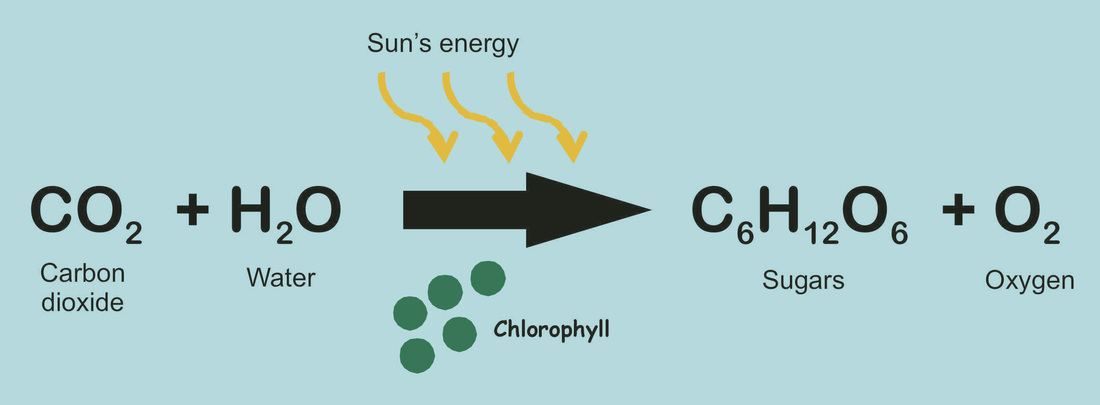
and photosynthesis as the reaction between carbon dioxide and water in the presence of chlorophyll and sunlight (energy) to produce glucose and oxygen

Photosynthesis

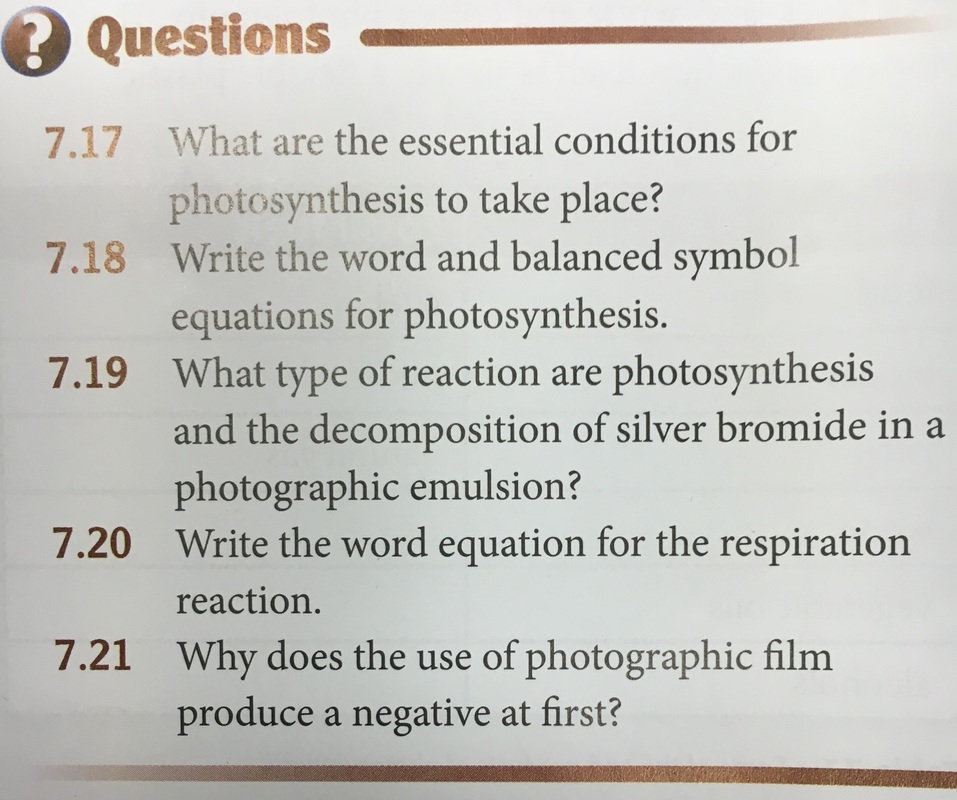
​Photosynthesis traps energy when sunlight falls on leaves containing the green pigment chlorophyll, the reaction converts water and carbon dioxide into glucose and oxygen. the plant will then use the glucose to make starch and other carbohydrates. Photosynthesis is the reverse reaction of that which occurs in all living things; respiration. The energy that is stored by plants in this process is called biomass energy.
Picture
Picture
Photography
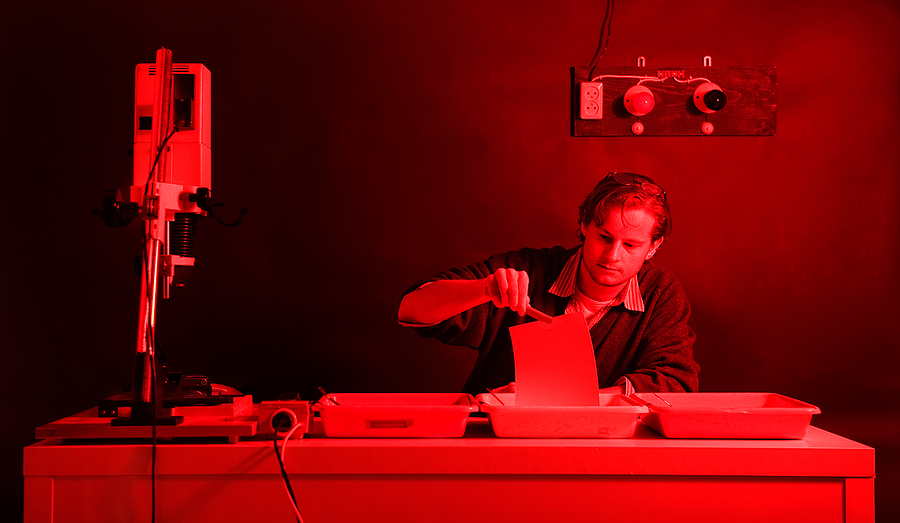
Silver salts also have a photochemical reaction, when exposed to light they get darker. The darkening is caused by the salts decomposing into their constituent elements.  
For example:
2AgBr --> 2Ag +Br2
This is also a redox reaction because the bromide ions lose electrons and the silver ions gain electrons.
This photochemical reaction was the basis of all black and white and colour photography. Photographic film was made from a flexible plastic coated in a light sensitive emulsion of silver salts. Where the film is exposed to the most light the silver solid is precipitated out and so darkens the film. This was called the negative image and they would need to be used to create the final image as they would be a reversal of the true image.
Substitution reaction of Alkanes with Chlorine
This links into what you will learn later with organic chemistry. Simply put when exposed to the ultraviolet light in sunlight chlorine molecules will split into separate energised atoms.

These atoms will then readily react with methane (CH4so the overall reaction is that the chlorine atom replaces (substitutes) one of the hydrogens on the methane molecule to gove chloromethane (CH3Cl).

With lots of chlorine this reaction can repeat until all of the hydrogens have been substituted giving the product of tetrachloromethane (CCl4).

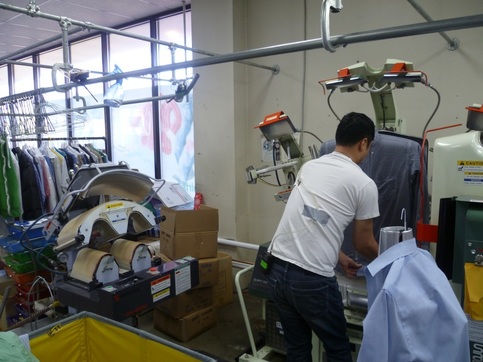
You may have heard of some of the chemicals formed in this way; trichloromethane is commonly known as chloroform which was an early anaesthetic, another chemical made in the same way, 1,1,1-trichloroethane, is the solvent used in dry-cleaning.
Picture
Picture

Check Understanding

Picture

Home Study Tasks

c2c.1a_worksheet.doc
File Size: 51 kb
File Type: doc
Download File

c2c.2a_worksheet.doc
File Size: 80 kb
File Type: doc
Download File

c2c.4a_worksheet.doc
File Size: 47 kb
File Type: doc
Download File

c2c.5_worksheet.doc
File Size: 257 kb
File Type: doc
Download File

c2c.6_worksheet.doc
File Size: 49 kb
File Type: doc
Download File

Powered by Create your own unique website with customizable templates.
Photo used under Creative Commons from UCL Mathematical and Physical Sciences
  • KS3
    • Year 7 Physics >
      • Physmath >
        • 1 Adding, Subtracting, Multiplying & Dividing
        • 2 Fractions and Percentages
        • 3 Ratios, Reciprocals and Rounding
        • 4 Interpreting Charts
        • 5 Interpreting Graphs
        • 6 Making Estimations
        • 7 Units
        • 8 Unit Prefixes
        • 9 Rearranging equations
      • Energy >
        • 1 What is Energy
        • 2 Conservation & Energy Transfer
        • 3 Chemical & Thermal Energy
        • 4 Light & Sound Energy
        • 5 Gravitational & Elastic Energy
        • 6 Kinetic Energy
        • 7 Electrical Energy
        • 8 Electrical Generators
        • 9 Non-Renewable Energy Resources
        • 10 Renewable Energy Resources
        • 11 Cost of Electricity
        • 12 Revision
        • 13 End of Topic Test
        • 14 Review End of Topic Test
        • 15 Extension 1 - Work Done
        • 16 Extension 2 - Power
      • Electricity >
        • 1 Electrons
        • 2 Static Electricity
        • 3 Circuit Symbols
        • 4 Series Circuits
        • 5 Current
        • 6 Voltage
        • 7 Resistance
        • 8 Parallel Circuits
        • 9 Series vs Parallel Part 1
        • 10 Series vs Parallel Part 2
        • 11 Investigation Part 1
        • 12 Investigation Part 2
        • 13 Fuses & RCDs
        • 14 End of Topic Test
        • 15 Review End of Topic Test
      • Magnetism
    • Year 8 Physics >
      • Sound >
        • 1. Sound Waves
        • 2. Speed of Sound
        • 3. Echoes and Sonar
        • 4. Sound Calculations
        • 5. How we hear Sound
        • 6. Amplitude & Decibels
        • 7. Investigating Volume Part 1
        • 8. Investigating Volume Part 2
        • 9. Leveled Assessment
        • 10. Review Leveled Assessment
        • 11. Frequency and Hearing range
        • 12. Doppler Effect
        • 13. Ultrasound
        • 14. End of Topic Test
        • 15. Review End of Topic Test
      • Light >
        • 1 How Light Travels
        • 2 Opaque, Transparent Translucent
        • 3 Mirrors & Reflection
        • 4 Bending light, Refraction
        • 5 Light Investigation Part 1
        • 6 Light Investigation Part 2
        • 7 Spectrum, Splitting light, Prisms
        • 8 The Eye
        • 9 Colour
        • 10 Levelled Assessment Optics
        • 11 Review Levelled Assessment
        • 12 Shadows and Eclipses
        • 13 Concave and convex lenses
        • 14 End of Topic Test
        • 15 Reflection on End of Topic Test
      • Gravity
      • Thermal >
        • 1 Temperature
        • 2 Conduction
        • 3 Convection
        • 4 Radiation
        • 5 Particles & Heat Transfer
        • 6 Saving Heat
        • 7 Heat loss from the home
        • 8 U Values
        • 9 Thermometers
        • 10 Temperature Scales
        • 11 Boiling Points & Melting Points
        • 12 Expansion
        • 13 Heat in Space
        • 14 Specific Heat Capacity
        • 15 End of Topic Assessment
    • Year 9 Chemistry >
      • Metals 1 >
        • 1 Physical Properties of Metals
        • ​2 Chemical properties of metals
        • 3 Suitability of metals to their job
        • 4 Methods for making salts
        • 5 Particle Equations
        • 6 Levelled Assessment
        • 7 Reflection lesson for Levelled Assessment
        • 8 Metals with acids and their reactivities
        • 9 Metal oxides and acids
        • 10 Reaction Practical Part 1
        • 11 Reaction Practical Part 2
        • 12 Metal carbonates and acids 1
        • 13 Metal Carbonates and Acids 2
        • 14 Metal Salts in Society
        • 15 Revision
        • 16 Mid Topic Test
        • 17 Review Mid Topic Test
      • Metals 2 >
        • 18 Rusting & Corrosion
        • 19 Patterns of Metal Reacticity
        • 20 Reactivity Series
        • 21 Tests for gases
        • 22 Displacement theory
        • 23 ​Displacement Practical Part 1
        • 24 Displacement Practical Part 2
        • 25 Level Assessed Task
        • 26 Review Levelled Assessment
        • 27 Methods of Metal Extraction 1
        • 28 Methods of Metal Extraction 2
        • 29 End of Topic Test
        • 30 Review End of Topic Test
      • The Earth 1 >
        • 1 Structure of the Earth
        • 2. Alfred Wegener
        • 3. Earthquakes
        • 4. Volcanoes
        • 5. Igneous Rocks 1
        • 6. Igneous Rocks 2
        • 7. Weathering
        • 8. Sedimentary Rocks
        • 9. Fossils
        • 10. Metamorphic Rocks 1
        • 11. Metamorphic Rocks 2
        • 12. The Whole Rock Cycle
        • 13. Levelled Assessment
        • 14. Mid Topic Test
        • 15. Review Mid Topic Test
      • The Earth 2 >
        • 16. Ores
        • 17. Quarrying
        • 18. Quarrying Debate
        • 19. The Atmosphere
        • 20. Distillation of Air
        • 21. Combustion
        • 22. Combustion Practical Part 1
        • 23. Combustion Practical Part 2
        • 24. Global Warming
        • 25. Acid Rain
        • 26. Carbon Monoxide
        • 27. Global Dimming
        • 28. Man & the Environment
        • 29. End of Topic Test
        • 30. Review End of Topic Test
      • iGCSE Chemistry Taster Day
  • iGCSE
    • 1. The Particulate nature of matter >
      • 1.1 Solids, Liquids & Gases
      • 1.2 Changes of State
      • 1.3 Diffusion & Brownian Motion
    • 2. Experimental Techniques >
      • 2.1 Measurement
      • 2.2.1 Criteria of purity
      • 2.2.2 Methods of purification
    • 3. Atoms, elements and compounds
    • 4. Stoichiometry
    • 5. Electricity and Chemistry
    • 6. Chemical Energetics
    • 7. Chemical Reactions >
      • 7.1 Physical & Chemical Changes
      • 7.2 Rates of Reaction
      • 7.3 Reversible Reactions
      • 7.4 Redox Reactions
    • 8. Acids, Bases and Salts >
      • 4 Methods for making salts
    • 9. The Periodic Table
    • 10. Metals
    • 11. Air and Water
    • 12. Sulfur
    • 13. Carbonates
    • 14. Organic Chemistry
    • iGCSE Mock Data Analysis
  • International A level
    • UNIT 1: THE CORE PRINCIPLES OF CHEMISTRY - INCOMPLETE
    • UNIT 2: APPLICATION OF THE CORE PRINCIPLES - INCOMPLETE
  • About
  • Science Week 2016